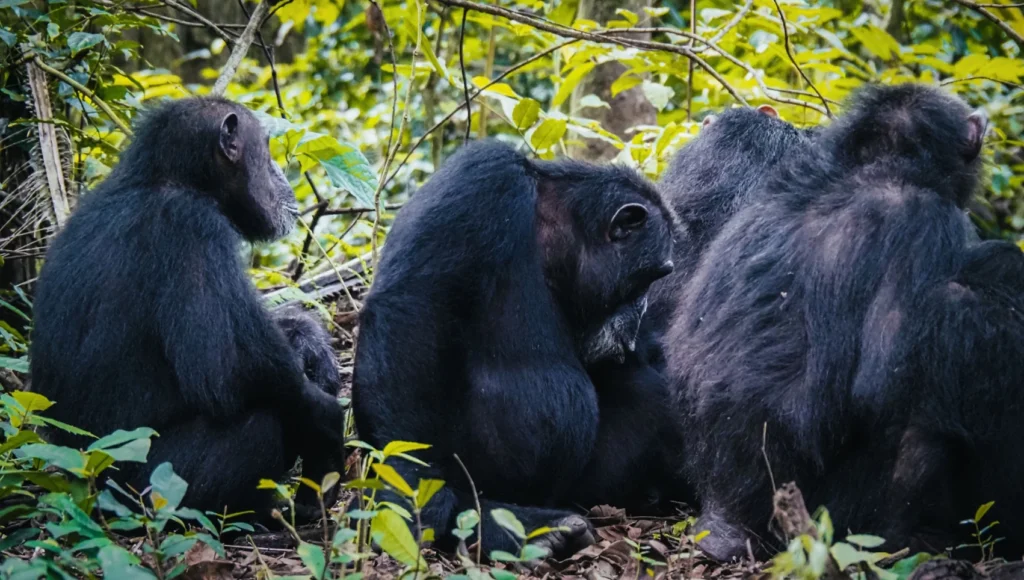
The conflict that shattered the illusion of innocent nature and changed primatology
forever

In the 1960s, when Jane Goodall began her historic research in Gombe National Park, Tanzania, the scientific world welcomed her discoveries with amazement. Chimpanzees used tools, showed affection, and seemed to embody a more peaceful and pure version of human beings. However, between 1974 and 1978, that idyllic image was dramatically shattered.
The Split and the Beginning of Hostilities | Until 1971, the Gombe chimpanzees belonged to a single large community. Gradually, however, internal tensions emerged that led to a real geographical split. In the north remained the Kasakela, the largest group led by aggressive males like Figan and Satan. In the south settled the Kahama, a smaller faction that included six adult males and three females.
On January 7, 1974, the latent tension exploded into systematic violence. A group of Kasakela
males ventured into enemy territory and brutally ambushed Godi, an isolated Kahama male. It was the first time humans documented an intentional and group murder among non-human primates.
A Strategy of Extermination | What followed was not a series of random brawls for food, but an organized war. For four years, the Kasakela organized silent “death squads” with a single goal: to hunt down and kill the members of the Kahama one by one. Not even old affectionate bonds offered protection: Goliath, once a respected leader of the entire united community, was brutally massacred by his former companions. By 1978, the Kahama faction was completely annihilated.
“Often I would wake in the night, horrific pictures springing unbidden to my mind… Satan,
cupping his hand below Sniff’s chin to drink the blood that welled from a great wound on his
face… Jomeo tearing a strip of skin from Dé’s thigh.“
— Jane Goodall, Through a Window
Jane Goodall’s Trauma and the Scientific Turning Point | For Jane Goodall, witnessing this spiral of violence was a devastating trauma. Seeing animals she knew intimately turn into ruthless killers threw her into a period of deep disillusionment. The scientist had to accept a harsh reality: chimpanzees possess a “dark side” terrifyingly similar to the human one. Our biological and evolutionary similarities did not only include intelligence or maternal love, but also tribalism, extreme territoriality, and the ability to plan mass violence.
Initially, the scientific community received the reports with skepticism, hypothesizing that
human interference had altered the animals’ behavior. However, subsequent studies have
confirmed the innate nature of such intergroup conflicts.
A Philosophical Legacy | The Gombe war redefined primatology and anthropology. It forced us to recognize that the roots of war and organized aggression lie deep in our evolutionary past, long before the birth of human civilizations. Chimpanzees remain extraordinary creatures, capable of immense
altruism, but their history reminds us that nature, in its truest mirror, can be as complex as it is ruthless.
And you, did you know this story?